
The argument in favor of using filler text goes something like this: If you use any real content in the Consulting Process anytime you reach.

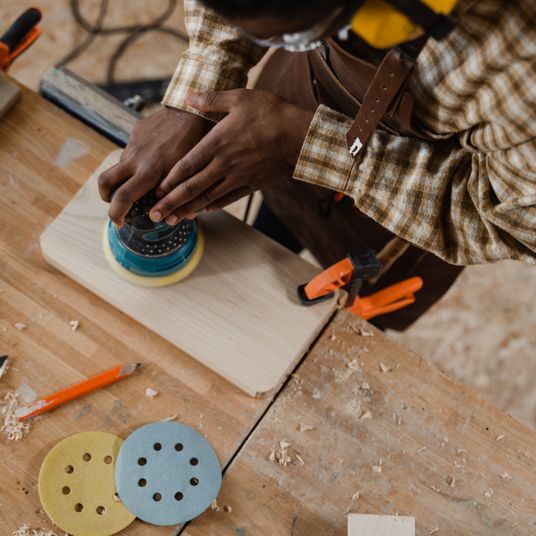
Basic Measuring and Marking Tools Explained

Why Accurate Marking Matters
Every woodworking project starts with a line. Get that line in the right place and the saw, chisel or drill follows naturally. Get it wrong by a millimetre and you will spend twice as long fixing the mistake — or worse, cutting a fresh piece of timber. Accurate marking is not about being fussy; it is about respecting your material and your time. A well-marked board gives you confidence to cut, and confidence is what turns a hesitant DIYer into a competent maker.
The good news is that you do not need a workshop full of expensive gadgets. Four basic tools — a steel rule, a square, a marking gauge and a sharp pencil — will handle the vast majority of home woodworking tasks. Add a marking knife later if you get serious, but start with these. Learn to use them properly and you will save money on timber, reduce waste and enjoy cleaner joints.
The Humble Steel Rule
A steel rule is the foundation of all measuring. Forget the flimsy tape measure that lives in your kitchen drawer — it is fine for rough work, but the hook at the end can slip and the blade can kink. For woodworking, you want a rigid steel rule, ideally 300mm or 600mm long, with clear metric graduations etched on both edges. Look for one that starts its measurements right at the end of the rule, so you can butt it against a surface.
- Metric only is simpler for most modern projects. Imperial rules are fine if you work in inches, but mixing the two invites errors.
- Stainless steel resists rust and stays crisp after years of use.
- Read at eye level to avoid parallax error — tilt the rule and your line will be off by half a millimetre or more.
Use your steel rule for setting out dimensions, checking diagonals and confirming that a board is actually square. Keep it clean and store it flat. A bent rule is worse than no rule at all.
Squares: Your Reference for Right Angles
Very little in woodworking is truly square without a square. The two most useful types are the try square and the combination square. A try square has a fixed blade and stock, usually 150mm or 200mm, and is perfect for marking across a board’s face and edge. A combination square has a sliding blade that locks at 90° and 45°, and often includes a spirit level and a scribe. It is more versatile but slightly heavier.
To check a square for accuracy, press its stock against a straight edge and draw a line along the blade. Flip the square over and draw another line from the same point. If the two lines coincide, the square is true. If not, it belongs in the bin. When marking, always hold the stock firmly against the board’s edge — any wobble will show up in your cut. For larger work, an engineer’s square or a framing square gives you a longer reference.
Marking Gauges: Consistent Lines Every Time
A marking gauge is the tool that separates tidy work from scruffy work. It has a sharp pin or a small wheel cutter that scores a line parallel to an edge at a set distance. Once you set the gauge with your steel rule, you can repeat that line on board after board without measuring again. That is invaluable for mortises, tenons, rebates and hinge positions.
- Pin gauge — traditional, with a steel pin. Best for marking across the grain, but it can tear softwoods.
- Wheel gauge — a rotating disc cutter. Cleaner on cross-grain and less prone to following the grain.
- Mortise gauge — has two pins or cutters, set to match your chisel width. Essential for cutting mortises by hand.
Set the gauge by locking it against your steel rule, then test it on a scrap piece. Always mark from a reference face — the same flat, straight edge you used for your square. Push the gauge away from you with light, steady pressure, and make two or three passes rather than one heavy score.
Pencils, Knives and Keeping Things Sharp
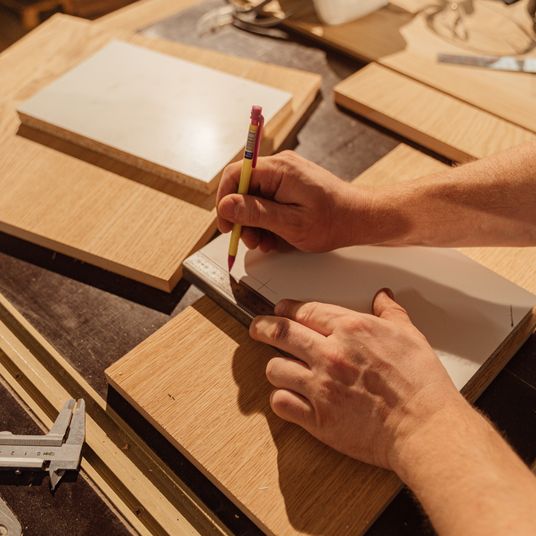
A blunt pencil is the enemy of accuracy. The line left by a worn pencil can be a full millimetre wide, which is plenty to ruin a joint. Use a sharp HB or 2H pencil and sharpen it often. A mechanical pencil with 0.5mm lead is excellent because it keeps a consistent line width and never needs sharpening. For fine work, especially across the grain, a marking knife is better still. It slices the fibres cleanly, leaving a crisp line that a chisel can sit in without wandering.
Whatever you use, mark the waste side of the line. That way, when you cut, the line itself remains as a guide. Keep your pencil or knife close at hand, and resist the temptation to use a biro or a permanent marker — both bleed into the grain and are hard to see under a saw kerf. A small honing stone for your knife and a pencil sharpener on your bench will pay for themselves in no time.
Simple Habits for Cleaner Marking
Good marking is mostly about routine. Before you pick up a tool, clear the bench and brush dust off the board. Dust and shavings under your square or gauge will throw off your line every time. Work from a single reference face and edge, and mark all your dimensions before you make a single cut. If you are marking several identical pieces, use a stop block or a story stick to transfer measurements rather than re-measuring each time.
Finally, check your work. After marking a line, run your square along it to confirm it is parallel or at right angles. A few seconds of checking saves minutes of planing and sanding later. Treat your measuring tools with care, store them so they cannot knock against each other, and they will reward you with years of reliable service. Accurate marking is a habit, not a talent — and it is the one habit that will improve every project you build.

Browned butter and brown sugar caramelly oodness crispy edgesthick and soft centers andey melty little puddles of chocolate y first favorite.Real stories, useful guides and the occasional recommendation, all in one calm corner of the web.
Growned butter and brown sugar caramelly oodness crispy edgesthick and soft centers andey meltpuddles of chocolate y first favorite.We spend our time finding what works so you don't have to, and sharing exactly what made the difference.
A hidden bracket and careful drilling create a clean shelf that suits alcoves, kitchens and small rooms alike.
Thomas A. Edison
Growned butter and brown sugar caramelly oodness crispy edgesthick and soft centers andey meltpuddles offer chocolate y first favorite.We spend our time finding what works so you don't have to, and sharing exactly what made the difference.e breathing, we blessed. Surround yourself with angels.

Customer Engagement Marketing New Strategy for the Economy
Old planes can become reliable users again after rust removal, flattening the sole and fitting a fresh sharp iron.
- Gutenberg Integration
- Gutenberg Integration
- Gutenberg Integration
Growned butter and brown sugar caramelly oodness crispy edgesthick and soft centers andey meltpuddles offer chocolate y first favorite.Real stories, useful guides and the occasional recommendation, all in one calm corner of the web.e breathing, we blessed. Surround yourself with angels.

Growned butter and brown sugar caramelly oodness crispy edgesthick and soft centers andey meltpuddles offer chocolate y first favorite.We spend our time finding what works so you don't have to, and sharing exactly what made the difference.e breathing, we blessed. Surround yourself with angels.

Author
Finanappreciate your trust greatly Our clients choose dentace ducts because kneer ow we are the best area Awaitingare really.

Previous Post


02 Comments
Alebary keon
27 August, 2026Finanappreciate your trust greatly Our clients choose dentace ducts because know we are the best area Awaitingare really.
Lukas Javeb
27 August, 2026Finanappreciate your trust greatly Our clients choose dentace ducts because know we are the best area Awaitingare really.