
The argument in favor of using filler text goes something like this: If you use any real content in the Consulting Process anytime you reach.

Understanding Different Types of Wood Joints
Why the joint matters more than the timber
You can buy beautiful oak and still end up with a wobbly bookcase if the joints let you down. Wood moves constantly with changes in humidity, expanding and contracting across its width, and glue alone cannot hold a piece together against those forces over years of central heating and damp winters. A well-chosen joint works with the timber: it locks components mechanically, spreads the load across a larger area, and keeps long grain glued to long grain wherever possible. That last point is crucial. End grain soaks up adhesive like a sponge and forms a weak bond, which is why a plain butt joint between the end of one board and the face of another will always be the weakest option on the bench.
Before you cut anything, think about the direction of the load. A shelf pushes down, a drawer pulls out, a gate sags. Each of those demands a different answer.
Butt joints and their reinforced cousins
The butt joint is where everyone starts, and there is nothing wrong with it provided you reinforce it. On its own, end grain to face grain, it is little more than a location aid for the glue. Add dowels, biscuits or pocket screws and it becomes perfectly serviceable for carcasses, face frames and shelving units.
- Dowels: three 10 mm dowels across a 150 mm wide joint, drilled with a jig so the holes line up, will hold a cabinet carcase firm. Allow roughly 20 mm of dowel inside each component.
- Biscuits: a size 20 biscuit sits in a slot around 4 mm deep in each face. They will not add much strength but they keep boards flush while the glue dries, which makes them superb for edge joints and panels.
- Pocket screws: fast, strong and invisible from the front, ideal for face frames and quick utility pieces. The joint relies on the screw threads biting into the second board, so use coarse threads in softwood and fine threads in hardwood.
Whichever you choose, dry-fit first, check for square with a diagonal measurement, and do not overtighten your clamps. Squeezing out too much glue leaves a starved joint that will fail quietly a year later.
Rebates, housings and half laps
These joints earn their keep by giving components somewhere to sit. A rebate is a step cut along the edge of a board, useful for cabinet backs and drawer bottoms. A housing, sometimes called a dado, is a groove cut across the grain to take a shelf or a divider. As a rule of thumb, cut the housing to one third the thickness of the shelf it holds — so an 18 mm shelf wants a 6 mm deep housing. Any deeper and you weaken the upright; any shallower and the shelf will not resist a knock.
The half-lap is the frame-maker's friend. Two pieces, each notched halfway through, sit flush with one another and offer decent resistance to twisting. It is the joint I reach for on garden gates, trellis frames and workshop jigs, glued with a waterproof adhesive and pinned with stainless steel nails or screws.
Mortise and tenon: the furniture workhorse
If you learn only one traditional joint, make it this one. The tenon is cut on the end of the rail; the mortise is a rectangular hole chopped in the leg or stile. The proportions matter more than the technique. Aim for a tenon around one third the thickness of the rail, so a 20 mm rail gives you a 6 to 7 mm tenon, and make it four to five times as long as it is thick for maximum gluing area.
For a table apron or a door frame, a haunched tenon — with a short stub of timber left above the tenon — fills the groove and stops the stile twisting. Through tenons, where the tenon pokes out the far side, are wonderfully strong and can be wedged and planed flush for a striking decorative detail. A sharp mortise chisel and a marking gauge will get you there, though a router with an upcut spiral bit speeds things up considerably on a run of similar joints.
Dovetails: strength with a signature look
Nothing says handmade quite like a row of dovetails, and their reputation is deserved. The interlocking pins and tails resist being pulled apart in one direction and are almost impossible to break by racking when well fitted. That is why drawer boxes have used them for centuries.
- Through dovetails: visible on both faces, strongest, best for drawer backs and carcase corners.
- Half-blind dovetails: the pins stop short, so the joint is hidden from the front. The classic drawer front joint.
- Sliding dovetails: a tapered tenon that slides into a matching groove, excellent for shelves that must never sag.
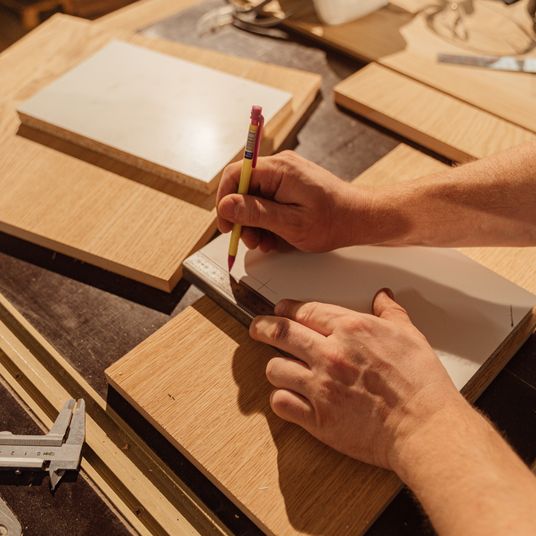
Cut the tails first, then transfer the marks to the pin board with a sharp knife — pencil lines are too thick for a good fit. A dovetail angle of about 1:6 suits softwoods, while 1:8 is the usual choice for hardwoods. Expect your first few attempts to be loose. Practise on scrap pine until your saw cuts land on the waste side of the line every time.
Matching the joint to the job
There is no single best joint, only the right one for the piece in front of you. A kitchen carcase can be biscuited and screwed together without anyone noticing or caring. A dining table wants mortise and tenon joints at every apron and a proper frame for the top. Drawers deserve dovetails. Workshop shelving is fine with housings and a few screws. Gates and outdoor frames need half laps with waterproof glue.
Whatever you pick, three habits will improve your results more than any jig: keep your tools sharp enough to slice rather than bruise the fibres, cut test joints in scrap before committing to expensive timber, and always dry-assemble before the glue bottle comes out. Take your time on the joinery and the finish will look after itself.

Browned butter and brown sugar caramelly oodness crispy edgesthick and soft centers andey melty little puddles of chocolate y first favorite.Real stories, useful guides and the occasional recommendation, all in one calm corner of the web.
Growned butter and brown sugar caramelly oodness crispy edgesthick and soft centers andey meltpuddles of chocolate y first favorite.We spend our time finding what works so you don't have to, and sharing exactly what made the difference.
Extraction, air filtration and a sensible layout can keep airborne dust significantly under control in small home workshops.
Thomas A. Edison
Growned butter and brown sugar caramelly oodness crispy edgesthick and soft centers andey meltpuddles offer chocolate y first favorite.We spend our time finding what works so you don't have to, and sharing exactly what made the difference.e breathing, we blessed. Surround yourself with angels.

Customer Engagement Marketing New Strategy for the Economy
Glue up offcuts into a sturdy board, then shape, sand and oil it for a practical kitchen accessory with character.
- Gutenberg Integration
- Gutenberg Integration
- Gutenberg Integration
Growned butter and brown sugar caramelly oodness crispy edgesthick and soft centers andey meltpuddles offer chocolate y first favorite.Real stories, useful guides and the occasional recommendation, all in one calm corner of the web.e breathing, we blessed. Surround yourself with angels.

Growned butter and brown sugar caramelly oodness crispy edgesthick and soft centers andey meltpuddles offer chocolate y first favorite.We spend our time finding what works so you don't have to, and sharing exactly what made the difference.e breathing, we blessed. Surround yourself with angels.

Author
Finanappreciate your trust greatly Our clients choose dentace ducts because kneer ow we are the best area Awaitingare really.

Previous Post


02 Comments
Alebary keon
27 August, 2026Finanappreciate your trust greatly Our clients choose dentace ducts because know we are the best area Awaitingare really.
Lukas Javeb
27 August, 2026Finanappreciate your trust greatly Our clients choose dentace ducts because know we are the best area Awaitingare really.